Mastering the Art History Timeline Explained
art history timeline explained

Mastering the Art History Timeline Explained

Journey through millennia of human creativity, understanding the forces that shaped our visual world and its enduring legacy.

Start Your Art Journey

Key Takeaways

  • ✓ Art history spans over 40,000 years, from prehistoric cave paintings to contemporary digital art.
  • ✓ Major art periods are often defined by geographical location, cultural shifts, and technological advancements.
  • ✓ Understanding the timeline reveals how societies expressed their beliefs, power structures, and daily lives.
  • ✓ Each art movement builds upon or reacts against its predecessors, creating a continuous dialogue through time.

How It Works

1
Explore Prehistoric & Ancient Art

Begin with the earliest human expressions, such as cave paintings and megalithic structures. Learn about the art of ancient civilizations like Egypt, Mesopotamia, Greece, and Rome, focusing on their distinct styles and purposes.

2
Navigate Medieval & Renaissance Eras

Delve into the religious focus of Medieval art, including Byzantine, Romanesque, and Gothic styles. Witness the rebirth of classical ideals and humanism during the Renaissance, marked by revolutionary techniques and iconic masters.

3
Discover Baroque to Modernism

Uncover the drama of Baroque, the elegance of Rococo, and the intellectual shifts of Neoclassicism and Romanticism. Progress through the 19th and early 20th centuries with Impressionism, Cubism, Surrealism, and other groundbreaking movements.

4
Engage with Contemporary Art

Conclude with the diverse and often challenging landscape of Post-War and Contemporary art. Understand how artists continue to push boundaries, exploring new materials, concepts, and societal critiques in the present day.

The Dawn of Creativity: Prehistoric and Ancient Art Foundations
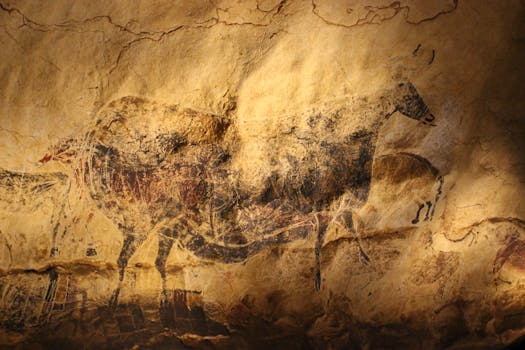
Explore the historic Lascaux cave painting, a UNESCO World Heritage site. Photo: toshihiko tanaka / Pexels
The story of art history begins not with formal academies or celebrated masters, but with the primal urge to create, to record, and to communicate. The earliest known artistic expressions date back tens of thousands of years, primarily found in prehistoric cave paintings and portable sculptures. These works, such as those in Lascaux or Altamira, depict animals, hunting scenes, and abstract symbols, offering invaluable insights into the beliefs and daily lives of early humans. Their purpose remains debated: were they magical rituals, instructional guides, or simply aesthetic expressions? Regardless, they represent humanity's first attempts to impose meaning and order upon their world. The transition from nomadic hunter-gatherer societies to settled agricultural communities brought about new forms of artistic expression. Megalithic structures like Stonehenge demonstrate early architectural prowess and an understanding of astronomical alignments, hinting at sophisticated social organization and spiritual practices. As civilizations began to flourish, particularly in regions like Mesopotamia and Egypt, art became increasingly intertwined with power, religion, and the afterlife. Mesopotamian art, including Sumerian, Akkadian, Babylonian, and Assyrian periods, is characterized by its monumental architecture, intricate cylinder seals, and relief sculptures that glorified rulers and deities. The Code of Hammurabi stele, with its detailed relief carving at the top, exemplifies the fusion of law, power, and artistic representation. Egyptian art, spanning thousands of years, is perhaps best known for its consistency and adherence to strict conventions. Hieroglyphs, tomb paintings, and colossal statues of pharaohs and gods were not merely decorative; they served crucial religious and funerary functions, ensuring the deceased's passage to the afterlife and the perpetuation of cosmic order. The iconic pyramids and the Sphinx stand as enduring testaments to this civilization's monumental ambition and artistic skill. The consistency of Egyptian artistic style over millennia speaks to a profound cultural stability and a belief system that valued tradition above individual innovation. Exploring ancient civilizations reveals the deep roots of human creativity. The next major shift arrived with the classical civilizations of Greece and Rome, which laid many of the aesthetic and philosophical foundations for Western art. Ancient Greek art, evolving through the Archaic, Classical, and Hellenistic periods, emphasized humanism, ideal beauty, and rational order. From the stylized kouroi and korai of the Archaic period, Greek sculpture progressed to the naturalistic and idealized forms of the Classical era, exemplified by works like the Parthenon sculptures and the Doryphoros by Polykleitos. The Greeks pioneered architectural orders (Doric, Ionic, Corinthian) that still influence design today. Roman art, while heavily influenced by Greek models, developed its own distinct character, marked by a greater emphasis on realism, portraiture, and practical applications like public works and propaganda. Roman engineering innovations allowed for grand architectural feats such as the Colosseum, the Pantheon, and vast aqueduct systems, often adorned with elaborate mosaics and frescoes. The Roman Empire's vast reach ensured the dissemination of these artistic forms across a wide geographical area, leaving an indelible mark on subsequent artistic traditions. This foundational era provides the essential context for understanding the evolution of art globally.

From Divine Inspiration to Humanism: Medieval and Renaissance Masterpieces
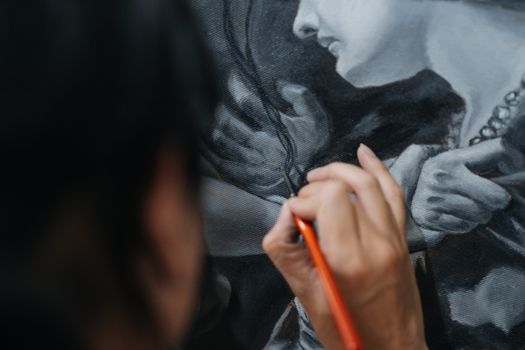
Close-up of artist carefully painting a detailed portrait using fine brushes. Photo: Huy Nguyễn / Pexels
Following the decline of the Roman Empire, Europe entered the period known as the Middle Ages, an era dominated by the rise of Christianity and the consolidation of religious authority. Medieval art, which spans roughly from the 5th to the 15th centuries, is characterized by its primary focus on spiritual themes, biblical narratives, and the glorification of God. Early Christian art initially adapted Roman forms but quickly developed its own iconography, often seen in catacomb paintings and sarcophagi. The Byzantine Empire, centered in Constantinople, fostered a distinct artistic style known as Byzantine art, recognizable by its shimmering mosaics, iconic religious images (icons), and flat, frontal figures with golden backgrounds, designed to evoke a sense of the divine and eternal. Ravenna's San Vitale basilica, with its opulent mosaics, is a prime example of this period's splendor and spiritual intensity. As Europe progressed, various regional styles emerged. Romanesque art (c. 1000-1200) was characterized by massive, thick-walled churches with rounded arches, barrel vaults, and intricate sculptural portals, often depicting terrifying Last Judgment scenes to instruct and inspire awe in pilgrims. The Bayeux Tapestry, a unique embroidered narrative, offers a secular glimpse into this era's storytelling capabilities. Gothic art (c. 1150-1400s), which originated in France, marked a revolutionary shift in architecture and aesthetics. Characterized by soaring pointed arches, ribbed vaults, flying buttresses, and vast stained-glass windows, Gothic cathedrals like Chartres and Notre Dame de Paris aimed to lift the worshiper's gaze heavenward, filling the interior with divine light. Sculpture became more naturalistic, and painting, though still largely religious, began to show increased emotional depth and realism. The intricate details and monumental scale of these structures demonstrate incredible artistic and engineering prowess, reflecting a profound faith that permeated all aspects of life. The 14th century saw the gradual emergence of proto-Renaissance styles, particularly in Italy, with artists like Giotto breaking from Byzantine conventions to introduce greater naturalism and emotional expression into painting. The true flowering of the Renaissance, however, began in 15th-century Italy, marking a profound intellectual and artistic 'rebirth' of classical ideals. This period emphasized humanism – the belief in the value and agency of human beings – and a renewed interest in classical antiquity's art, literature, and philosophy. Artists like Masaccio, Donatello, and Brunelleschi pioneered linear perspective, chiaroscuro, and anatomical accuracy, transforming painting, sculpture, and architecture. The High Renaissance (late 15th to early 16th centuries) brought forth titans like Leonardo da Vinci, Michelangelo, and Raphael, whose works epitomize the era's genius. Leonardo's Mona Lisa and Last Supper, Michelangelo's David and the Sistine Chapel ceiling, and Raphael's School of Athens represent pinnacles of artistic achievement, showcasing a mastery of form, composition, and emotional expression previously unseen. The Northern Renaissance, meanwhile, developed its own distinct character, focusing on meticulous detail, rich symbolism, and oil painting techniques, exemplified by artists such as Jan van Eyck and Albrecht Dürer. This era laid the groundwork for the modern concept of the artist as an intellectual and innovator, rather than just a skilled craftsman.

The Evolution of Expression: From Baroque Drama to Modernist Breakthroughs
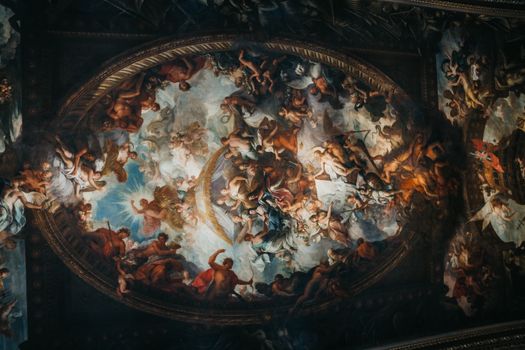
Intricate Baroque ceiling mural depicting religious themes in historic church interior. Photo: Andras Stefuca / Pexels
Following the High Renaissance, the art world underwent another significant transformation, ushering in the Baroque era (c. 1600-1750). Born partly out of the Counter-Reformation, Baroque art was characterized by its grandeur, drama, emotional intensity, and dynamic compositions. Artists like Caravaggio revolutionized painting with his dramatic use of chiaroscuro and gritty realism, while Gian Lorenzo Bernini's sculptures, such as 'The Ecstasy of Saint Teresa,' burst with theatricality and movement. In architecture, Baroque churches and palaces, like St. Peter's Basilica redesigned by Bernini, aimed to overwhelm the viewer with their scale and elaborate ornamentation, creating a sense of awe and spiritual fervor. The style spread across Europe, with distinct national variations; Rubens in Flanders, Rembrandt in the Netherlands, and Velázquez in Spain each brought their unique genius to the period, often exploring portraiture, genre scenes, and landscape alongside religious and mythological subjects. The subsequent Rococo period (c. 1730-1780) emerged as a lighter, more playful, and ornate evolution of the Baroque, characterized by delicate pastels, curvilinear forms, and themes of love, leisure, and aristocracy, exemplified by artists like Watteau and Fragonard. Understanding art movements helps connect these periods. The late 18th century witnessed a reaction against Rococo's perceived frivolity with the rise of Neoclassicism, a return to the perceived purity, order, and rationality of classical Greek and Roman art. Inspired by archaeological discoveries and Enlightenment ideals, artists like Jacques-Louis David used crisp lines, clear compositions, and heroic narratives to champion civic virtue and moral rectitude, famously seen in 'The Oath of the Horatii.' This intellectual rigor soon met its emotional counterpart in Romanticism (early 19th century), which prioritized intense emotion, individualism, the sublime in nature, and the exotic. Artists such as Eugène Delacroix, J.M.W. Turner, and Caspar David Friedrich explored dramatic narratives, turbulent landscapes, and the power of human feeling. This period set the stage for the tumultuous changes of the 19th and early 20th centuries. The mid-19th century saw Realism emerge, focusing on depicting everyday life and social realities without idealization. Courbet famously declared, 'Show me an angel, and I'll paint one.' This was quickly followed by Impressionism (1870s-1880s), a revolutionary movement that broke from academic traditions by emphasizing the fleeting effects of light and color, often painted outdoors (en plein air). Monet, Renoir, Degas, and Pissarro sought to capture the 'impression' of a moment rather than precise detail. Post-Impressionism, featuring artists like Van Gogh, Cézanne, and Gauguin, further pushed the boundaries of color, form, and emotional expression, laying the groundwork for modern art. The early 20th century exploded with groundbreaking movements: Fauvism with its wild colors, Cubism's fractured perspectives by Picasso and Braque, Expressionism's emotional intensity, and Surrealism's exploration of the subconscious mind. These movements collectively shattered traditional notions of representation and beauty, reflecting a world undergoing rapid technological, social, and psychological change. The abstract art of Kandinsky and Mondrian, and the radical Dada movement, challenged the very definition and purpose of art, pushing it into entirely new conceptual territories.

Navigating the Post-War and Contemporary Landscape: Tips for Understanding Modern Art

The period following World War II ushered in an era of unprecedented artistic experimentation and diversity, often referred to as Contemporary Art. This period is characterized by a rejection of singular dominant styles and an embrace of pluralism, concept, and new media. Understanding this complex landscape requires a shift in perspective from purely aesthetic appreciation to a deeper engagement with the artist's intent and the cultural context. Here are some tips for navigating and appreciating post-war and contemporary art: * **Embrace Conceptual Art:** Many contemporary works prioritize ideas over traditional aesthetics. Don't just ask 'Is it beautiful?' but 'What is it trying to say?' Artists like Joseph Kosuth ('One and Three Chairs') challenged the nature of art itself. Look for the underlying philosophical or social commentary. * **Consider the Context:** Art is always a product of its time. The Cold War, globalization, technological advancements, and social movements (civil rights, feminism, environmentalism) have profoundly shaped contemporary art. Knowing the historical backdrop helps unlock meaning. * **Explore New Materials and Media:** Contemporary artists frequently use unconventional materials (found objects, industrial materials) and new media (video art, performance art, digital art, installation art). Be open to these expanded definitions of what constitutes 'art.' Think of Nam June Paik's pioneering video art or Yayoi Kusama's immersive installations. * **Engage with Performance and Participatory Art:** Some contemporary art is ephemeral, existing only for the duration of a performance, or requires audience participation. These forms challenge traditional notions of art as a static object. Marina Abramović's long-duration performances are key examples. * **Look for Social and Political Commentary:** Many contemporary artists use their work to critique society, politics, identity, and power structures. Think of the feminist art movement, or works addressing racial injustice. Artists like Kara Walker and Ai Weiwei are prominent in this realm. * **Don't Fear Abstraction:** While abstraction began earlier, it diversified significantly in the post-war era with movements like Abstract Expressionism (Jackson Pollock, Mark Rothko) and Minimalism (Donald Judd, Carl Andre). Focus on color, form, texture, and the emotional impact rather than seeking recognizable subjects. * **Visit Galleries and Museums:** The best way to understand contemporary art is to experience it firsthand. Many pieces are site-specific or gain their full impact in person. Engage with the wall texts and museum guides. * **Read and Research:** Contemporary art often benefits from explanation. Reading artist statements, critical reviews, and academic texts can provide valuable frameworks for interpretation. Contemporary art is a dynamic, ongoing dialogue. It reflects our current world, challenges our perceptions, and often pushes us out of our comfort zones. By approaching it with an open mind and a willingness to engage with its diverse forms and ideas, you can unlock a rich and rewarding experience.

Comparison

FeatureRenaissance ArtBaroque ArtImpressionist Art
Dominant ThemeHumanism, Classical RevivalReligious Zeal, Drama, PowerLight, Color, Everyday Life
CompositionBalanced, Symmetrical, Linear PerspectiveDynamic, Diagonal, EmotionalSpontaneous, Loose, Asymmetrical
Key ArtistsLeonardo, Michelangelo, RaphaelCaravaggio, Bernini, RubensMonet, Renoir, Degas
Emotional ImpactCalm, Idealized, RationalIntense, Theatrical, GrandioseFleeting, Sensory, Atmospheric

What Readers Say

"This article on the art history timeline explained everything so clearly! I always felt overwhelmed by the sheer volume of information, but this broke it down perfectly. I finally feel like I grasp the major movements and their connections."

Sarah J. · Austin, TX

"As an aspiring artist, understanding the historical context is crucial. This resource delivered an incredibly helpful and comprehensive art history timeline explained in an engaging way. It's now my go-to reference."

Mark D. · Brooklyn, NY

"I used this guide to prepare for my art history exam, and it significantly improved my understanding of the periods. My grade went from a C to an A thanks to the clear explanations and thoughtful structure provided by this art history timeline explained."

Emily R. · Seattle, WA

"The depth of information here is fantastic, especially the later sections on contemporary art. While I wish there were more visual examples, the written explanations for each art history timeline explained period are exceptionally well-researched and insightful."

David L. · Chicago, IL

"Even as a casual art lover, this article made the complex world of art history accessible and enjoyable. It's perfect for anyone wanting a structured overview of the art history timeline explained without feeling like they're reading a textbook."

Sophia G. · Miami, FL

Frequently Asked Questions

What is the most important period in the art history timeline explained?

There isn't a single 'most important' period, as each era contributed uniquely to the evolution of human expression. However, the Renaissance is often considered a pivotal moment due to its profound impact on Western art, reintroducing classical ideals and pioneering techniques that laid the foundation for much of subsequent art history. Early Modernism also dramatically reshaped our understanding of what art could be.

Is it difficult to understand the art history timeline explained if I'm not an art expert?

Absolutely not! This guide is designed for everyone, from beginners to seasoned enthusiasts. We break down complex concepts into digestible sections, focusing on key characteristics, influential artists, and the cultural context of each period. You don't need prior expertise to appreciate the journey through art history.

How can I remember all the different art movements and periods?

A great strategy is to focus on understanding the overarching themes and characteristics of each period, rather than memorizing individual dates. Try to identify how each movement either reacted against or built upon the previous one. Creating your own mental 'timeline' with key visual examples or artists can also be very effective for retention.

Why is understanding the art history timeline explained valuable today?

Understanding the art history timeline provides crucial context for appreciating contemporary art and culture. It reveals how societies have expressed their values, beliefs, and challenges over millennia, offering insights into human nature and historical developments. It also enhances critical thinking and visual literacy, allowing you to interpret and engage more deeply with the world around you.

How does this art history timeline explained compare to a university course?

While this article provides a comprehensive and in-depth overview, a university course would typically delve into much greater detail, often focusing on specific regions, artists, or theoretical frameworks, and would include assignments, discussions, and direct interaction with professors. This guide serves as an excellent foundational resource, offering a structured and accessible entry point to the subject that complements or prepares you for more formal study.

Who should use this guide to the art history timeline explained?

This guide is ideal for students seeking to supplement their studies, art enthusiasts wanting a structured overview, travelers preparing for museum visits, or anyone curious about the rich tapestry of human creativity. It's designed for those who want a clear, engaging, and in-depth understanding of how art has evolved through the ages.

Are there any risks to misinterpreting art history?

The primary 'risk' is forming incomplete or anachronistic interpretations by viewing past art through a purely modern lens, or by not considering the original cultural and historical context. This guide aims to mitigate that by providing context for each period, encouraging a more nuanced and informed understanding, allowing you to appreciate art on its own terms.

What are the future trends in the art history timeline explained?

Future trends in art history often involve interdisciplinary approaches, incorporating digital humanities, postcolonial studies, and gender studies to re-evaluate existing narratives. There's also a growing focus on global art histories, moving beyond a Eurocentric perspective, and increased attention to ephemeral, performance, and digital art forms as they become part of our historical record.

Embark on your journey through the captivating art history timeline explained. Whether you're a student, an art lover, or simply curious, this comprehensive guide will illuminate the path of human creativity across millennia. Start exploring today and deepen your appreciation for the world's most enduring artistic legacies.

Topics: art history timeline explainedart movements historyhistorical art periodsevolution of artvisual arts chronology
Leo List

DK Escorts LU Escorts AT Escorts SE Escorts FI Escorts CH Escorts DE Escorts HR Escorts IE Escorts GR Escorts CZ Escorts NO Escorts BE Escorts FR Escorts SI Escorts IL Escorts NL Escorts PL Escorts HU Escorts ES Escorts IT Escorts PT Escorts SK Escorts RO Escorts ZA Escorts UY Escorts US Escorts UK Escorts NZ Escorts AU Escorts
Brampton weed
Adultwork EstrelaBet Vai de Bet R7 Bet Betão Galera Bet Rainbet Bet9ja Shop SportyBet BetKing Sisal Loto Foot Hollywoodbets YesPlay Odibets RushBet Jugabet BetWarrior BetCity MSport betPawa Fortebet